
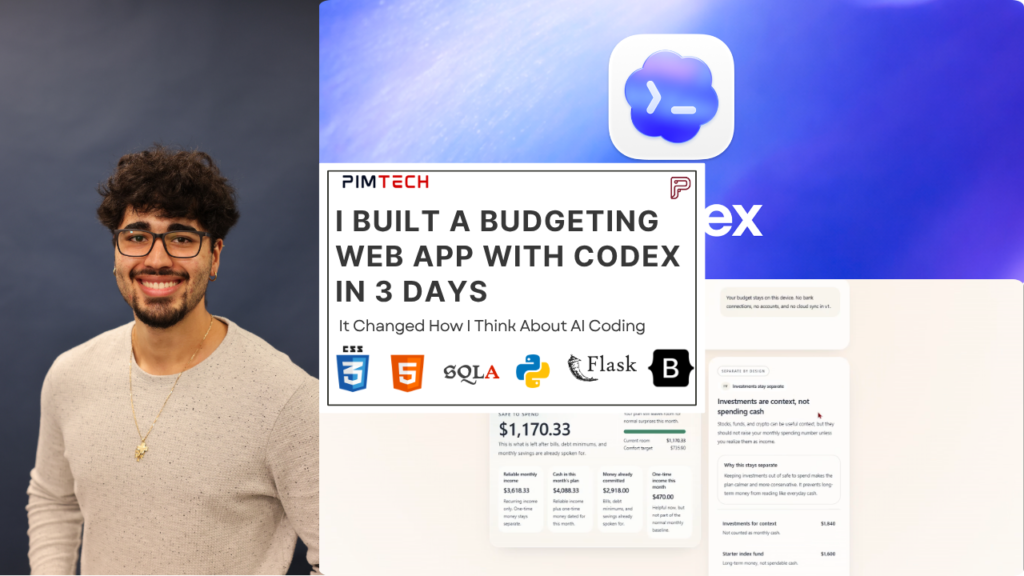
A simple question started this project
Three days ago, I wasn’t trying to make a statement about AI.
I was trying to answer one question:
Can an AI coding tool actually help a solo builder move from idea to usable product fast enough for it to matter?
Not in theory. Not in a polished demo. Not in a social media post.
I wanted to test it for myself.
Why I chose this idea
I decided to build something I would genuinely use: a budgeting web app.
I wanted it to feel:
- simple
- calm
- clean
- useful
- beginner-friendly
I also wanted it to avoid what frustrates me in many existing apps:
- too much clutter
- too many unnecessary features
- confusing interfaces
- paywalls too early
So instead of waiting until I felt “fully ready,” I opened Codex and started building.
What surprised me the most
At first, I expected Codex to help the way many people still imagine AI coding tools help:
A few snippets here. A few suggestions there. Maybe some cleanup.
That is not what happened.
What surprised me most was how quickly it became more than an assistant.
It became a momentum generator.
Very early on, it was already helping shape:
- the app structure
- UI components
- budget planning logic
- the overall flow of the product
And I remember thinking:
“Wait… it built this much already?”
That was the moment I realized the conversation around AI coding is changing.
The real challenge is no longer starting
Before, one of the biggest struggles in building software was getting started.
Blank page. Blank editor. No structure. No momentum.
Now, the challenge feels different.
The challenge is no longer just:
Can AI write code?
In many cases, it clearly can.
The deeper question is:
What happens when code can be produced faster than it can be understood?
That is where this project became really interesting for me.
What I built
The app is still a work in progress, but it already became something real enough to test and improve.
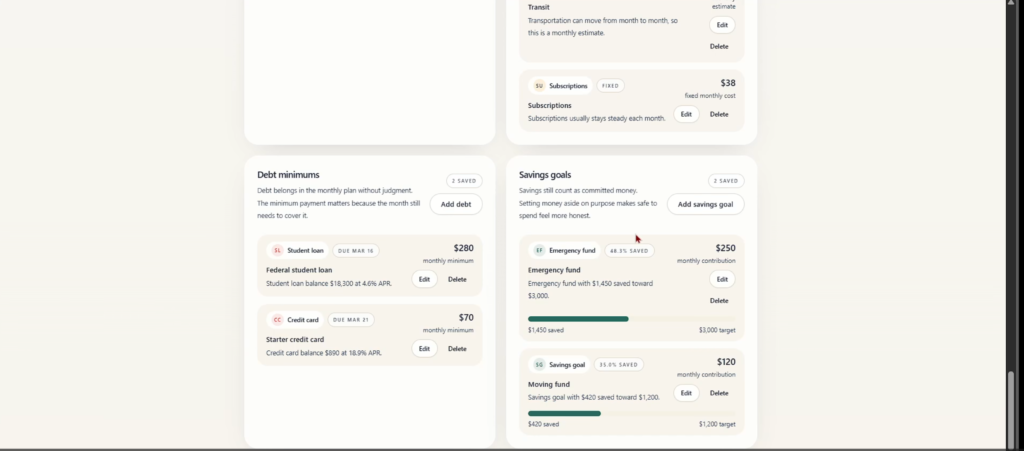
I built it as a local-first budgeting web app designed to help users understand what they can actually afford after their responsibilities are accounted for.
The goal was clarity over complexity.
Core ideas behind the app
- Track income in a realistic way
- Separate recurring and one-time money
- Plan around bills, debt, and savings
- Show a “safe to spend” number
- Keep the experience simple and non-intimidating
Some of the features I focused on
- recurring income
- one-time income
- monthly and biweekly planning
- debt tracking
- savings goals
- backup/export options
- a clean, mobile-friendly interface
I wanted it to feel premium and approachable, not technical.
Something useful for people.
Below is an example of how the app looks.
What this project taught me
This experience made one thing very clear:
AI can speed up building. But speed is not the same as understanding.
That distinction matters.
Because a working app is not automatically a trustworthy app.
A generated codebase is not automatically a validated codebase.
And that means the responsibility does not disappear. It actually increases.
Now the work becomes:
- knowing what to ask for
- guiding the direction clearly
- checking whether the logic makes sense
- validating what the tool produces
- taking responsibility for what gets shipped
To me, that is the real shift.
My honest opinion after 3 days
After using Codex seriously for this project, my view is somewhere between the extreme opinions online.
I do not think tools like this are useless.
And I also do not think they are magic.
What I do think is this:
AI coding tools are changing the shape of the work
They lower the friction between idea and prototype.
They help solo builders move faster.
They make it easier to turn an idea into something visible and testable.
But they also make it more important to have:
- judgment
- direction
- taste
- validation
- ownership
Because if you use these tools carelessly, you can end up with something dangerous:
a codebase that looks impressive, moves fast, and maybe even works… but one you do not truly understand.
And that can create false confidence very quickly.
The bottleneck is shifting
That may be my biggest takeaway from this project.
The bottleneck is shifting.
Less of the struggle is:
“Can I start?”
More of the struggle is:
“Do I understand what I’m building well enough to trust it?”
That is a very different kind of challenge.
And honestly, I think it is the challenge that matters most.
Why I’m sharing this now
I’m sharing this before everything is perfect because I think there is value in talking about the process honestly.
Not just the polished result.
I recently graduated, and I’m still learning. I’m building in public, experimenting in public, and trying to understand where these tools actually fit in the real world.
This project left me feeling two things at the same time:
motivated because I saw what is possible now, and humbled because I also saw how easy it is to confuse output with mastery.
That tension is real.
And I think more people should talk about it.
Final takeaway
If I had to summarize the experience in one idea, it would be this:
AI coding tools can absolutely help turn an idea into something real faster than before.
But the real skill is no longer only writing code.
The real skill is learning how to direct, evaluate, and take responsibility for what gets built.
That is the part I am still learning.
And honestly, that is the part I find most exciting.
What do you think?
Have you used AI coding tools like Codex, Copilot, Cursor, or others?
Did they make you trust your process more? Or did they make you question it more?
I’d love to hear your thoughts.
If you want to see what I built, explore the app here: Budget App
If you want the full behind-the-scenes process, watch the video here: YouTube Video
And if you’d like to see more of my work and projects: paoloibanezmedina.com